

Published 4/25/2026
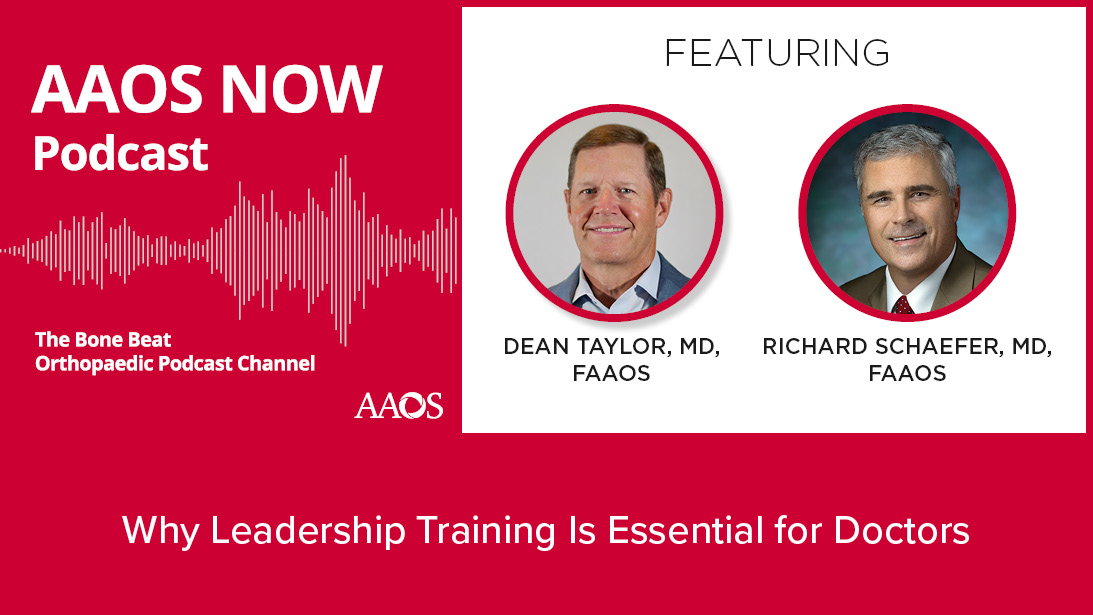
In episode two of season eight of the AAOS Now Podcast, Richard Schaefer, MD, FAAOS, welcomed Dean Taylor, MD, FAAOS, a sports medicine orthopaedic surgeon, retired Army colonel, and chair of the Feagin Leadership Program at Duke University, Durham, North Carolina, for a conversation on leadership training in orthopaedics.
Dr. Schaefer opened the conversation by asking Dr. Taylor to describe the origins of the Feagin Leadership Program. Dr. Taylor explained how his interest in leadership development came from his years at West Point, which he described as a premier leadership institution. After joining the Duke faculty in 2006 following his military retirement, he recognized an opportunity to intentionally integrate leadership education into fellowship training.
Inspired in part by Jim Collins’s book, “Good to Great,” Dr. Taylor believed his new program (named in honor of Dr. John Feagin, a mentor whose legacy of leadership deeply influenced Dr. Taylor) would differentiate itself by emphasizing leadership development alongside technical and clinical excellence. He stated that leadership education became “the game changer” and helped establish Duke as one of the top sports medicine programs in the country.
Although it began with sports medicine, Dr. Taylor explained, the Feagin Leadership Program eventually expanded to include scholars from a variety of other specialties — from neurosurgery to cardiology to anesthesiology and more.
Defining leadership in healthcare
When Dr. Schaefer asked Dr. Taylor how he defined leadership within healthcare, Dr. Taylor explained that the Feagin Leadership Program uses an inclusive definition centered on patient benefit. Healthcare leadership, he explained, is “the ability to influence others for the benefit of patients and patient populations.” He emphasized that by using this definition, leadership is not limited to physicians or administrators; everyone in a healthcare system has the capacity to influence outcomes and, as such, everyone has the capacity to be a leader. Dr. Taylor explained that even individuals outside traditional leadership roles can meaningfully improve care if they are empowered with leadership skills, and he stressed that patient-centeredness distinguishes healthcare leadership from leadership in other fields.
Key competencies for effective leadership
The conversation then shifted to the specific skills Dr. Taylor believes are essential for effective healthcare leadership. Dr. Taylor explained that his team identified key competencies, with patient-centeredness serving as the core principle guiding all decisions. He then highlighted the foundational competencies of service, integrity, teamwork, and critical thinking. Finally, he noted that emotional intelligence is the keystone skill that sits at the top of the model. Patient-centeredness alone is insufficient, he said, as leaders can unintentionally damage teams and culture if they lack emotional intelligence.
Dr. Taylor described emotional intelligence as “the ability to recognize and understand thinking and emotions in yourself and others and to use that awareness to manage your behavior in relationships.” He further clarified that there are many facets to emotional intelligence, including self-awareness, self-management, social awareness, and relationship management.
To underscore the importance of emotional intelligence, he shared a story with Dr. Schaefer. As he was about to enter the exam room to meet with a patient, his nurse stopped him to let him know the patient had recently suffered a huge personal loss. Dr. Taylor explained his ability to recognize his nurse would not have interrupted him in that moment were it not vitally important, and take the time to listen to her, enabled him to quickly adjust his approach to the exam and center the patient’s needs. He and the patient spent most of the appointment talking about her loved one, and he emphasized they would address her physical problem another time.
Past and future leaders
In the final portion of the episode, Dr. Schaefer asked Dr. Taylor to talk about mentorship and lessons he has learned about leadership throughout his life. Dr. Taylor reflected on his relationship with Dr. Feagin, describing his friend and mentor as an exemplar of physician leadership who made others feel valued. He shared Dr. Feagin’s leadership mantra, which he uses to this day: “Do the right thing, at the right time, for the right reasons.”
Dr. Taylor also shared some of the mistakes he made early in his career, including moments when his behavior undermined team culture and possibly had a negative impact on individuals. He then contrasted his early behaviors with later moments in his career after he received training and began to embrace and embody the core tenets of healthcare leadership that he outlined earlier in the episode.
When Dr. Schaefer asked Dr. Taylor what advice he would offer to residents and young surgeons who are interested in becoming successful healthcare leaders, Dr. Taylor emphasized how the first step is just that: being interested in learning how to lead effectively. He explained that leadership skills can be taught only if individuals have the desire to learn them.
Finally, Dr. Taylor noted that failure is an inevitable part of growth. He encouraged aspiring leaders to develop emotional intelligence, teamwork skills, and patient-centered values. The conversation concluded with Dr. Taylor emphasizing how intentional leadership education has the power to transform healthcare culture and help return medicine to its roots as a caring, patient-centric profession.
Listen to the episode — and subscribe to catch future episodes of the AAOS Now Podcast, offering expert insights to help orthopaedic surgeons stay informed, enhance their practices, and provide the best possible care for their patients.