

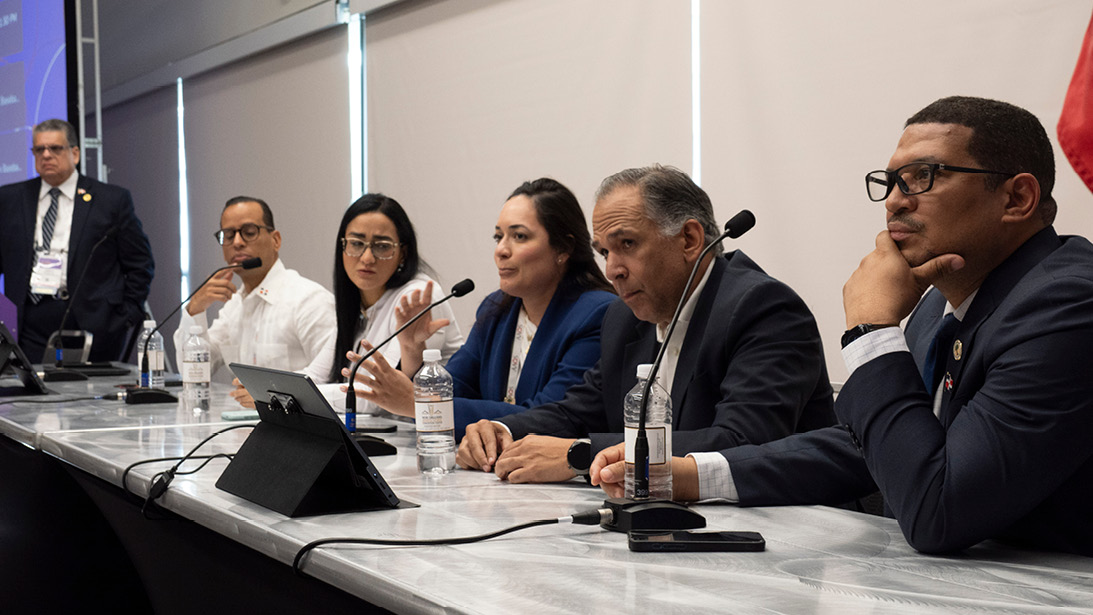
From left: Jose A. Taveras, MD; Elido Aníbal Pérez González, MD; Elena M. Vargas de Peña, MD; Milor Rodriguez Rosario, Sr., MD; Arturo R. Bisono, Sr., MD; and Ramon Saldana, MD.
Published 4/25/2026
|
Derek F. Papp, MD, FAAOS
The symposium “From Growth Plates to Game Day — Elbow Injuries in Youth and Adult Baseball Players in the Dominican Republic” delivered a fast‑moving overview of throwing‑related elbow pathology across all levels of play. Presented by leaders from the Dominican Society of Orthopedics and Traumatology (SDOT), the session was part of the Dominican Republic’s participation as the 2026 AAOS Guest Nation, bringing unique clinical insights shaped by the country’s deep ties to baseball.
With almost every seat in the room filled, members of AAOS’ Guest Nation shared their experiences with baseball medicine and specific sports healthcare concerns in the Dominican Republic. Jose A. Taveras, MD, gave opening remarks explaining the importance of baseball to the Dominican people, not only as a sport to watch but as a potential profession for many Dominican youths. Youth athletes must balance early velocity training, (often high) pitch counts, limited structured rehab, and pressure to return from injury with their overall health.
“Our interest in conservative management is that even a scar can keep athletes from signing a contract,” Dr. Taveras said.
Elido Aníbal Pérez González, MD, then discussed the kinetic chain and the forces the elbow sustains during throwing, highlighting the various classifications of throwing elbow pathologies seen in baseball athletes. He highlighted ultrasound as a useful diagnostic tool on the field or in the clubhouse.
Elena M. Vargas de Peña, MD, followed with a discussion of risk factors for injury in baseball athletes. As they do in some locations in the United States, Dominican baseball players often specialize early and play eight months or more each year, thereby accruing “cumulative microtrauma.” She identified catchers as a population also at risk for throwing injuries, as they throw almost as much as pitchers; catchers who also pitch occasionally are at even higher risk. She further delineated the different pathologies athletes encounter, which often depend on the patients’ age.
Milor Rodriguez Rosario, Sr., MD, focused on youth athletes and those with open physes, who often sustain injuries to their growth plates rather than the surrounding soft tissues. She also shared a couple of cases: In one, a 13-year-old pitcher had a medial elbow injury where Dr. Rosario used dynamic ultrasound in addition to MRI to help with diagnosis and treatment. The patient did well with platelet-rich plasma (PRP) injection and conservative management. In the second case, a 14-year-old had a displaced medial epicondyle fracture treated operatively with screw fixation. This patient also fully returned to play after the fracture healed, and he finished his rehabilitation.
Arturo R. Bisono, Sr., MD, spoke about the mature athlete in the Dominican Republic, explaining the baseball academy training system and the differences between Major League Baseball-affiliated players, players in Asian academies, and unaffiliated players. He explained athletes face different pressures depending on their career stages and shared his experience helping athletes play professionally, including in MLB, Japan, Korea, Taiwan, and the competitive Dominican Leagues.
Finally, Ramon Saldana, MD, spoke about the use of orthobiologics in helping his athletes return to play. Many athletes in the country want to exhaust every nonsurgical option before considering surgery, and Dr. Saldana shared his experiences. He explained that the cost of PRP in the Dominican Republic does not prohibit its use — typically, PRP can be offered at a fraction of the price usually offered in the United States.
With baseball season — from youth to professional leagues — in full swing, surgeons can expect more throwing-related elbow injuries. The experience of these Dominican Republic surgeons offers a playbook worth keeping close.
Derek F. Papp, MD, FAAOS, is a sports medicine surgeon at Baptist Health Orthopaedic Institute, Tavernier, Florida, and a member of the AAOS International Committee.