


Kelsey H. Collins, PhD
Published 4/25/2026
The 2026 New Emerging eXperts in Translational Science (NEXT) Award was presented to Kelsey H. Collins, PhD, for her research on the role of fat tissue as a key contributor to osteoarthritis (OA). While OA has been categorized as a “wear and tear” condition associated with aging, Dr. Collins’ translational studies demonstrate that OA may be a systemic condition influenced by metabolic and immune factors, with fat being a key contributor to OA development and pain. Dr. Collins received the award during the AAOS 2026 Annual Meeting in New Orleans last month.
Kelsey H. Collins, PhD
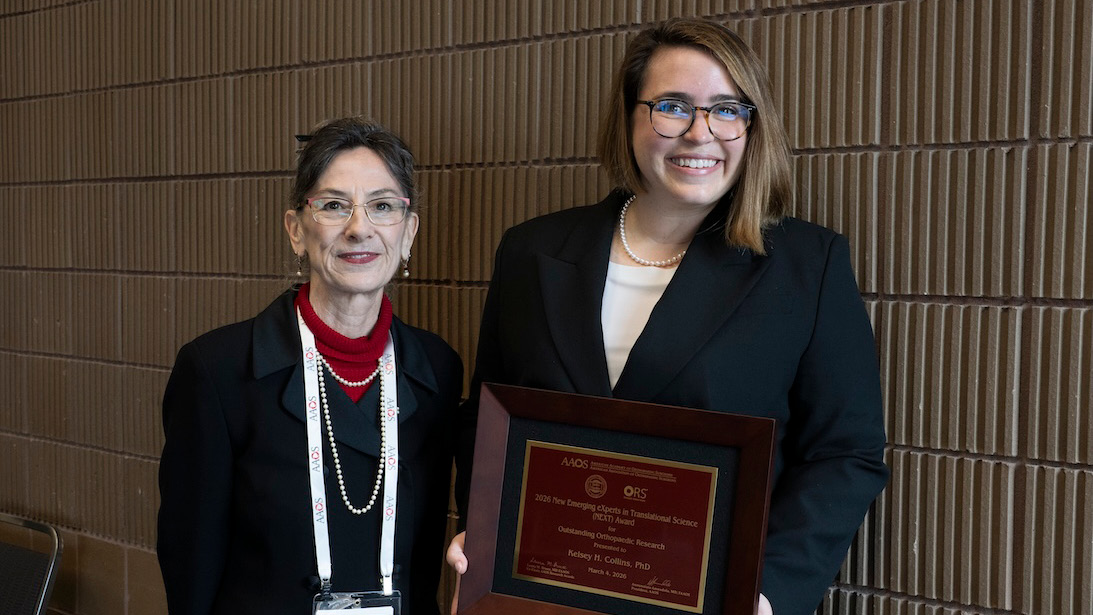
Kelsey H. Collins, PhD (right) poses with her award and Laura M. Bruse, MD, FAAOS, co-chair of the AAOS Research Committee.
Prevalence and impact
OA, the most common type of arthritis, occurs when cartilage surrounding the ends of the bone gradually wears away, resulting in pain and stiffness in the joints. OA affects more than 32.5 million Americans, typically impacting those older than the age of 50 and those who had a prior joint injury. There is no cure for OA, but there are many successful treatment options. The estimated economic burden of OA has doubled in the last decade, reaching more than $136 billion per year.
“From a very young age, my mother struggled with an aggressive form of arthritis. At one point, she was told that she’d be wheelchair-bound, but biologic drugs changed her life,” Dr. Collins said. “I saw how the functional limitation and pain are what really matter to patients, and pain is something they must live and navigate with until they get a total joint replacement, or new solutions are created. As someone who struggled with knee injuries themselves, I wondered why there were not biologics or other therapies for OA. This gap in understanding, and the opportunity to think about biologic development for OA, was a space that I was very interested in when I started my career in research.”
Tracing how OA develops
Since beginning her PhD studies at the University of Calgary, Canada, under Walter Herzog, PhD, and continuing her postdoctoral work with Farshid Guilak, PhD, Dr. Collins has focused her research on how adipose tissue (body fat) drives OA and pain. Her work has uncovered novel insights into the role of fat-derived factors involved in OA development and their interactions with fat-secreted factors and the immune system. However, she started on this path through her work in human movement biomechanics research.
Dr. Collins was inspired to pursue the question of how obesity drives OA from formative experiences as a trainee on the Alberta Innovates Health Solutions OA Team — where her supervisor, Dr. Herzog, and other key opinion leaders in the field, like committee member Cyril Frank, MD, led an interdisciplinary initiative to try to develop new solutions for OA. In one of these team meetings, Gillian Hawker, MD, FRCPC, shared that the team was missing a key target population — the role of obesity and multimorbidity — on OA pathogenesis. At the same time, Dr. Guilak, who went on to be Dr. Collins’ postdoc mentor, and Tim Griffin, PhD, a postdoc at the time, had recently published cutting-edge work demonstrating that obese mice lacking certain signals, like leptin, were protected from OA. Leptin is a hormone secreted by fat responsible for satiety, or telling people they are full, but is now understood to have pro-inflammatory actions in OA. Collectively, these events inspired Dr. Collins to delve deep into this question, which has become the foundation for this award, her training, and now her independent research program.
To understand the mechanistic influence of systemic adipose on the joint and how to identify mediators of communication between fat and joints, Dr. Collins and her team designed and adapted obesity models and tools to report changes in serum and synovial fluid with obesity and injury.
Dr. Collins and other researchers hypothesized that OA is actually a whole-body disease of pain and loss of physical function, a result derived from fat outside the joints. This focus creates a new area of research defining adipose-derived factors that drive OA and pain, and potentially leading to the discovery of new drivers, therapeutic candidates, and treatment strategies.
As excess fat tissue has been associated with OA development, Dr. Collins set out to determine if body fat, not body mass, is a significant driver of OA development through a well-defined rat model of diet-induced obesity. This approach used a high-fat, high-sucrose, obesity-inducing diet, which is similar to a Western-type diet. In a validation study, obese rats that underwent anterior cruciate ligament transection, sham, or no surgery all had knee joint damage, demonstrating that diet alone could drive OA in this model.
Like humans, rats in the high-fat, Western-type diet model had a variable and random response to weight gain but still gained fat, resulting in some rats gaining fat without gaining more body weight. These obesity-resistant rats were compared to rats that responded to diet by gaining both mass and body fat. This rat model was used to understand how body fat and body mass are related to OA disease without an injury at 12 and 28 weeks. It was shown the Western-type diet can drive damage. The researchers observed significant correlations between body fat percentage and Modified Mankin Score — the odds of having a top score of OA damage — demonstrating a strong relationship between body fat and knee joint damage with diet-induced obesity, again illustrates that the relationship between obesity and OA is not simply a problem of mechanical overloading. These studies also corroborated a role for leptin.
“In medicine, practitioners manage diseases with the best solution available at the time,” Dr. Collins said. “When people have knee pain, the assumption is that it is driven by something isolated to the knee, and it is intuitive in most practices to think about the patient’s age. However, when we and others started asking questions about whether sex differences, obesity status, and aging can drive differential trajectories or phenotypes of disease, we saw patterns suggesting that perhaps OA is not an endpoint of all these things that are systemic — and instead, maybe it can drive these multimorbidities and even drive aging. With these data, our hope is people will start to think a bit bigger about the importance of managing OA as a central node of whole patient health.”
Fat tissue and fat-derived factors as OA drivers
Dr. Collins’ research then looked to determine how fat is influencing other tissues, such as the knee joint, to cause OA development. The research team developed a fat-free mouse model of lipodystrophy (LD) — a condition where there is complete or partial loss of fat tissue. To test the relationship between adipose tissue and its secretory factors on cartilage pathology, they superimposed an injury, mimicking OA, by destabilizing the medial meniscus (DMM). While LD mice showed many clinical signs of OA as seen in those with obesity, including inflammation and muscle weakness, these mice were protected from cartilage damage and pain when challenged with DMM. This allowed Dr. Collins and her team to begin to determine how adipose tissue affects the joint. The protection was seen in male and female mice, even when challenged with DMM and a high-fat diet, showing that this protection from a lack of fat tissue cannot be overridden by diet or sex.
In further research, Dr. Collins’ team found that susceptibility to cartilage damage and pain with DMM can be reintroduced in LD mice through a small fat graft, demonstrating adipose tissue and its associated paracrine signaling are mediators of joint degeneration. These findings identify some new candidate therapeutic factors and further corroborate existing factors, such as leptin. Importantly, they are among the first to demonstrate the role of adipose tissue in OA and the development of musculoskeletal pain, supporting the hypothesis that OA may have systemic origins involving adipose tissue outside the joint.
“Dr. Guilak taught me that the best way to prove yourself right is to try to prove yourself wrong,” Dr. Collins said. “We have all these technologies now that enable unbiased discovery, allowing us to step back and determine if the patterns we find support our findings on their own. My mentors have not been afraid of new tricks, and I’ve been trained in environments where people aren’t threatened by a new and better understanding of how OA develops.”
For future work, Dr. Collins plans to break down the interface between fat signaling, obesity, and aging to find more novel molecular drivers of pain and validate those identified in her mouse studies. Once the molecular, cellular, or nervous system factors responsible for the joint crosstalk driving OA have been determined, novel cell-based regenerative medicine approaches and new biologic drugs can be developed.
Funding for the NEXT Award is provided by AAOS and the Orthopaedic Research Society.
References
- Griffin TM, Huebner JL, Kraus VB, Guilak F. Extreme obesity due to impaired leptin signaling in mice does not cause knee osteoarthritis. Arthritis Rheum. 2009;60(10):2935-2944. doi:10.1002/art.24854.
- Berenbaum F, Wallace IJ, Lieberman DE, et al. Modern-day environmental factors in the pathogenesis of osteoarthritis. Nat Rev Rheumatol. 2018;14:674-681.
- Berenbaum F, Griffin TM, Liu-Bryan R. Review: Metabolic regulation of inflammation in osteoarthritis. Arthritis Rheumatol. 2017;69:9-21.
- Collins KH, Hart DA, Reimer RA, et al. Response to diet-induced obesity produces time-dependent induction and progression of metabolic osteoarthritis in rat knees. J Orthop Res. 2016;34:1010-1018.
- Collins KH, Haugen IK, Neogi T, Guilak F. Osteoarthritis as a systemic disease. Nat Rev Rheumatol. 2026;22(2):105-117. doi:10.1038/s41584-025-01332-8.