


Published 8/26/2026
|
Ahmed K. Emara, MD
Editor’s note: The Final Cut is a recurring editorial series written by a member of the AAOS Now Editorial Board.
With few exceptions, we tend to conclude every total hip and knee arthroplasty case with some iteration of a high five or fist bump. It’s a quiet acknowledgment of a job well done. But a voice in my head will ask, “Was this case truly ‘fist-bump worthy?’”
That question became my gateway into patient-reported outcome measures (PROMs), which represent a structured attempt to quantify patients’ experience after surgery and, by extension, operative success. In pursuing this interest, I studied how different diagnoses, particularly primary osteoarthritis versus secondary arthritic conditions, shape postoperative improvement following total hip and knee arthroplasty. I examined thresholds such as minimal clinically important difference (MCID), substantial clinical benefit (SCB), and patient acceptable symptom state (PASS) and demonstrated, consistent with previous literature, that these thresholds are not fixed values but rather moving statistical targets. Similarly, these thresholds may vary according to the type of arthroplasty procedure, such as hip arthroplasty versus resurfacing.
At first, with each analysis, model, and additional layer of score stratification, it felt as though we were moving toward an increasingly precise understanding of outcomes. However, as the research questions continued to mature, it became clear we were delving further into analyzing a proxy, and proxies do not always reflect the true state.

Ahmed K. Emara, MD
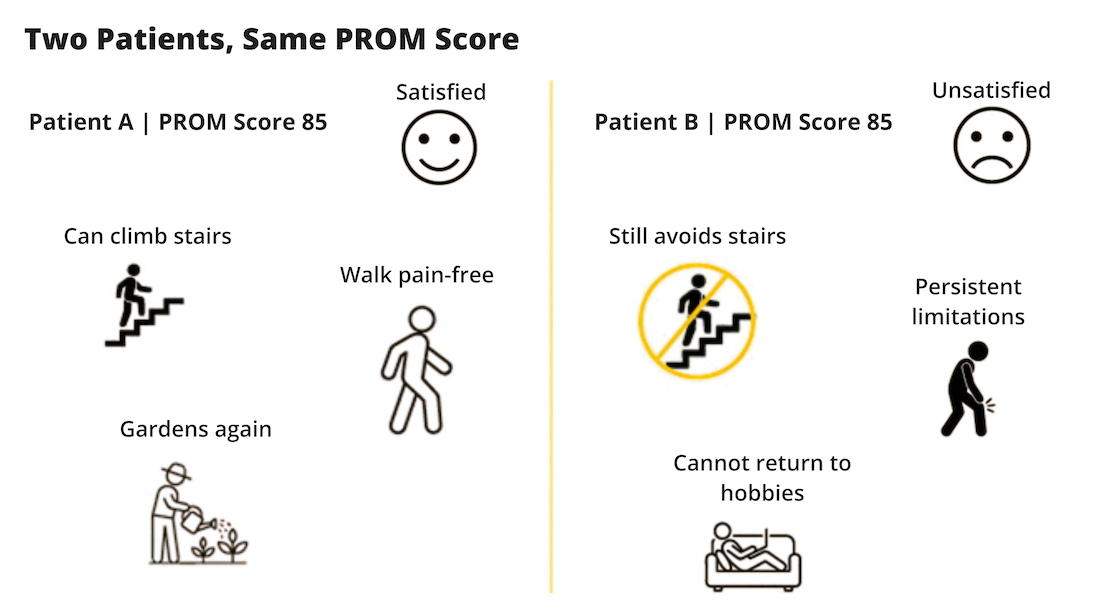
Patient-reported outcome measures (PROMs) do not always capture what matters most to individual patients. Although both patients in this example have the same PROM score, one has returned to valued activities and reports satisfaction, while the other continues to experience limitations. Satisfaction may depend less on the overall score than on whether treatment restores the specific activities and functions that patients prioritize.
In clinic, I would observe patients whose scores told one story while their lived experience suggested another. Two patients could reach the same postoperative score, lie within the same preoperative “phenotype,” and achieve the same magnitude of improvement yet walk away feeling very differently about the result of their surgery. One would describe a “regained life” and return to activities that mattered to them, while the other, with nearly identical numbers, would feel the joint remained unsatisfactory. Even more puzzling, one patient would report immense satisfaction with their surgery despite failing to achieve the MCID, while another reported poor satisfaction despite achieving a numerical PASS threshold.
There is little dispute today that patient expectations, psychological factors, medical comorbidities, preoperative sedative, opioid, or stimulant use, and other variables all contribute to the satisfaction equation. Nevertheless, the realization that patients could undergo similar PROMs improvements yet have dissimilar end satisfaction levels indicated that something gets lost in translation. While PROMs are evaluated as a net score, they are, at their core, a group of relevant individual questions. And my fellow researchers and I began to wonder whether, in our effort to understand and categorize this sum, we had overlooked the possibility that the individual parts — in this case, the questions themselves — can hold variable importance and weight between individual patients who have dissimilar priorities in terms of individual activity parameters, pain generators, and function patterns. Indeed, while we had become very good at defining statistical thresholds (MCID, SCB, and PASS) and predicting who would cross them, perhaps we should have focused on which aspects of recovery actually make patients feel the surgery was successful rather than what score defines success.
Looking beyond aggregate scores: What matters most to patients?
The next logical step in this thought process seemed to be to examine individual items within the HOOS (Hip Disability and Osteoarthritis Outcome Score) and KOOS (Knee injury and Osteoarthritis Outcome Score) instruments. What is the relative weight of each question assessing pain and function, and how well does each question independently predict patient satisfaction? After all, we know that PROMs as an aggregate score can be murky, but each measure is designed to gauge discrete and relevant activities and aspects of a patient’s postoperative state.
What we found felt both intuitive and, in some ways, overdue. Not all questions carry the same weight. Certain experiences, such as walking up and down stairs without pain, rising effortlessly from a chair, prolonged standing, or returning to recreational and higher-level functional activities, demonstrated a far stronger relationship with satisfaction than improvements in other domains. Similarly, questions tied to confidence in movement and the ability to perform meaningful daily activities appeared to matter more to patients than broader aggregate improvements in function alone. Improvements in these specific areas were much more strongly associated with satisfaction than equivalent changes elsewhere. In other words, the distinction between satisfied and unsatisfied patients was not always the total score, but whether the recovery restored the parts of life that patients themselves valued most (Figure 1).
Understanding the meaningful aspects of a patient’s life before surgery may offer valuable insights into setting expectations and influencing the course of postoperative rehabilitation and recovery, thereby helping us achieve a parameter of success that is shared by the patient and surgeon. After all, if patient-centered care is a goal, transitioning from a numerical radiographic success parameter (e.g., postoperative radiographs) to a numerical statistical assessment (e.g., postoperative PROMs) does not get us closer to our aims.
We do not think these findings diminish the value of PROMs; however, the findings did change how we think about them. PROMs should not be considered endpoints in themselves, nor should they be used as a sole marker of success. However, they can point us toward general patterns of favorable or adverse outcomes, which we can use as springboards for a deeper examination of patient experience.
As surgeons and researchers, it is tempting to anchor ourselves to clean, comparable, and reassuringly objective numbers. However, this may very well come at the expense of missing the bigger picture, since patient recovery is rarely that simple. This journey has been a reminder that sometimes we lose sight of the forest for the trees, but at other times, we lose sight of the nature of the individual trees that make the forest what it is.
Ahmed K. Emara, MD, is a senior orthopaedic surgery resident at Cleveland Clinic. Dr. Emara is chair of the AAOS Resident Assembly Education Committee and a member of the AAOS Now Editorial Board.
References
- Emara AK, Benyamini B, Pasqualini I, et al. What matters most for patient satisfaction following total knee arthroplasty? J Knee Surg. 2025;38(12):601-610. doi:10.1055/a-2607-9835.
- Benyamini B, Emara AK, Pasqualini I, et al. Mapping the importance of each individual element of HOOS and HOOS Physical Function Shortform in driving satisfaction following primary total hip arthroplasty. J Arthroplasty. 2025. PMID: 40399733.