

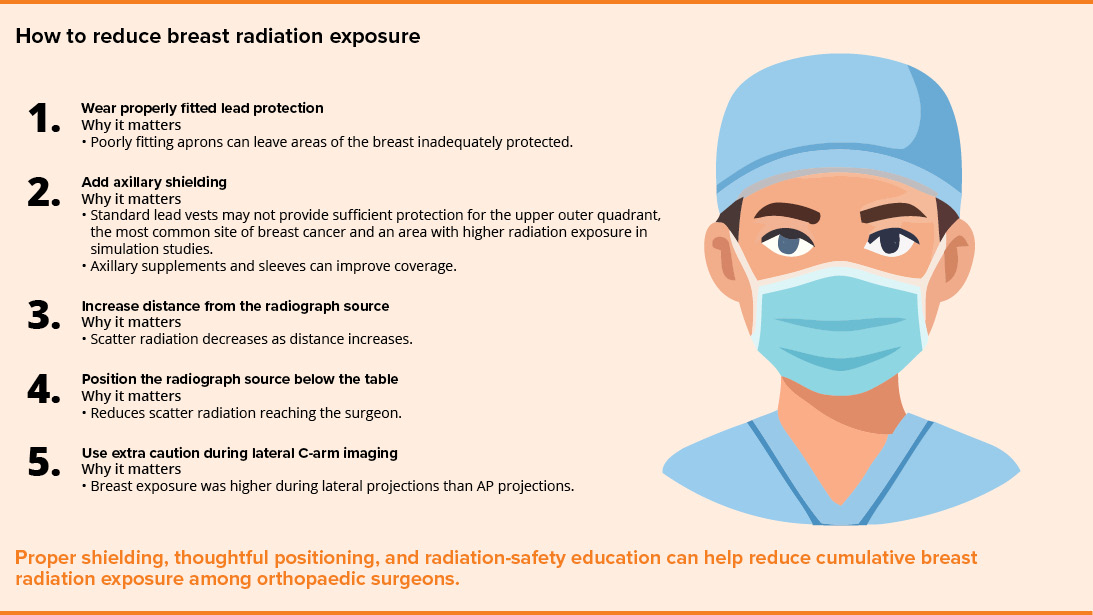
Figure 1. Properly fitted lead protection, axillary shielding, increased distance from the radiation source, thoughtful C-arm positioning, and adherence to radiation-safety protocols may help reduce cumulative occupational radiation exposure. The infographic highlights practical steps surgeons and institutions can take to improve breast protection in the operating room.
Source: Adapted from Valone LC, Chambers M, Lattanza L, James MA. Breast radiation exposure in female orthopaedic surgeons. J Bone Joint Surg Am. 2016;98:1808-1813. doi:10.2106/JBJS.15.01167.
Published 8/26/2026
|
Hilton P. Gottschalk, MD, FAAOS, FAOA
At a Glance
- Breast cancer rates appear higher among female orthopaedic surgeons.
- Occupational radiation exposure may contribute to cumulative risk.
- Proper shielding and radiation safety practices can reduce exposure.
Estimated read time: 4 minutes
Editor’s note: The AAOS Committee on Healthcare and Safety is committed to educating members on occupational risks that affect surgeons across all stages of their careers. This article is the first in a three-part series examining key occupational hazards in orthopaedics, with the goal of increasing awareness and promoting safer clinical environments.
I can tell you exactly where I was when I found out that my wife was diagnosed with Stage 3B invasive lobular carcinoma of the breast. Like all hardworking orthopaedic surgeons, I was in clinic when my phone rang, and the oncologist (one of my medical school friends) gave me the biopsy results.
Over the last year, my wife went through five months of rigorous chemotherapy, religiously wearing her cold cap to save whatever hair she could. This was followed by bilateral mastectomies and axillary node dissection. Because 17 of the 23 nodes were still positive for cancer cells, she underwent 33 doses of radiation therapy. Since the tumor is hormone sensitive, multiple medications are required to block estrogen as well as other medications to help prevent recurrence (all with their own side effects). Complications from treatment included an infected tissue expander, radiation-induced plexopathy, and lymphedema (requiring an additional surgery that was denied by our insurance).
While this experience is deeply personal, it also raises broader concerns for our profession, especially as more women enter orthopaedic surgery. They may face occupational risks that disproportionately affect them.
Occupational exposures are both frequent and cumulative
Multiple studies have shown the increased prevalence of breast cancer in female orthopaedic surgeons. In 2022, Chou et al. surveyed 672 female orthopaedic surgeons and found “a 1.89-fold higher prevalence of all-cause cancer and a 3.97-fold higher prevalence of breast cancer” when compared with the US female population. Other studies also confirmed that our female colleagues are at higher risk than the general population. Proposed reasons for this higher prevalence include higher socioeconomic status, delayed childbearing, lifestyle factors, and occupational exposures.
---
Related Content
- Survey reveals gaps in radiation risk awareness among female orthopaedic surgeons (AAOS Now)
- AAOS Information Statement on Radiation Safety (AAOS)
---
In orthopaedic surgery, these occupational exposures are both frequent and cumulative, including fluoroscopy use, long operative times, and repeated radiation exposure over the course of a career. Because these exposures are often considered routine, their long-term implications, particularly for breast tissue, may not be fully appreciated in daily practice.
Radiation exposure deserves closer attention
The most significant source of occupational exposure is ionizing radiation from fluoroscopy. What is interesting is that it is difficult to prove that radiation exposure alone is accountable for the increased prevalence: The cause is multifactorial. Multiple studies have looked at ionizing radiation and the risk of breast cancer, but it becomes difficult to prove statistical significance. Another study by Chou and colleagues compared female orthopaedic surgeons to plastic surgeons and urologists and found “no difference between the observed and expected prevalence of breast cancer among plastic surgeons and urologists.”
Another factor to consider is standard fluoroscopy versus the mini-fluoroscope. Chou et al. suggest that the mini-fluoroscope may be associated with increased breast cancer prevalence given “the X-ray source [is] closer to the patient, which increases the scatter radiation compared with the standard fluoroscope.”
Either way, several questions remain. How well are our female colleagues being protected from this ionizing radiation? Are certain areas more exposed than others? Valone et al. asked these exact questions and used an anthropomorphic torso phantom, simulating the female surgeon. They simulated a patient on a standard operating table and studied several variables to better understand how to protect the upper outer quadrant (UOQ) of the surgeon’s breast — the most common breast cancer site. They found that breast radiation exposure was higher in “a C-arm lateral projection compared with an anteroposterior projection. Higher dose-equivalent rates were observed for the UOQ compared with the lower inner quadrant of the breast and for aprons that were too small or too large.”
Although a direct causal relationship remains difficult to establish, the consistency of findings across multiple studies suggests that occupational exposure may play a meaningful role. This uncertainty underscores the importance of precautionary measures, especially since the risk can be modified by lead protection, even in the absence of definitive causation.
Improved protection starts with better shielding
Armed with the knowledge from the Valone et al. study, we can better educate current practitioners in the use of protective shielding (Figure 1). The study authors recommend the following: “1) using properly fitted lead aprons and/or vests to protect the breast; 2) increasing the distance between the surgeon and the X-ray source, especially with use of the C-arm in the lateral position; 3) increasing the distance between the X-ray source and the patient to decrease scatter radiation; 4) positioning the X-ray source beneath the operating table or on the contralateral side of the surgeon when possible; and 5) educating surgeons and trainees about radiation safety.”
Taking this one step further, Van Nortwick et al. looked at different lead vest designs and supplements. They found that the UOQ of the breast was not adequately protected by standard lead vests alone or even vests with wings. To better protect the tissue, axillary supplements and sleeves were required.
Incorporating these practices into routine operative workflow — not just during high radiation cases — can significantly reduce cumulative exposures over time.
Moving from awareness to prevention
Given the higher prevalence of breast cancer in female orthopaedic surgeons, it is critical that we move beyond awareness to action. Hospitals, training programs, and individual surgeons play a role in improving radiation safety practices:
- Advocate for properly fitted individualized protective equipment for all surgeons and trainees.
- Consider providing axillary supplements and sleeves during surgical cases involving fluoroscopy.
- Incorporate formal radiation safety education into residency and continuing education.
- Routinely evaluate equipment storage, maintenance, and fit.
- Engage institutional leadership to prioritize radiation safety initiatives.
“Breast cancer prevention in orthopaedic surgery begins long before a diagnosis, as many female orthopaedic surgeons have been diagnosed with breast cancer,” said Antonia Chen, MD, MBA, FAAOS, president of the American Association of Hip and Knee Surgeons. “Every case is an opportunity to choose well-fitted lead, add axillary protection, confirm your lead is intact, minimize radiation exposure, and stay vigilant with age- and risk-appropriate breast imaging. As orthopaedic surgeons, we protect our patients every day, so we must protect ourselves with the same commitment.”
As members of the orthopaedic community, we have an opportunity and responsibility to better protect ourselves and our colleagues. Increased awareness is only the first step; meaningful change requires consistent action at both the individual and institutional levels.
Hilton Gottschalk, MD, FAAOS, FAOA is a dual-fellowship-trained pediatric orthopaedic and hand surgeon in Austin, Texas. He is an assistant professor of surgery and perioperative care at the Dell Medical School at the University of Texas in Austin. He is a member of the AAOS Committee on Healthcare and Safety, and he has a very patient and amazing wife!
References
- Chou LB, Chandran S, Harris AHS, Tung JT, Butler LM. Increased breast cancer prevalence among female orthopedic surgeons. J Womens Health. 2012;21:683-689. doi:10.1089/jwh.2011.3342.
- Chou LB, Johnson B, Shapiro LM, et al. Increased prevalence of breast and all-cause cancer in female orthopedic surgeons. JAAOS Glob Res Rev. 2022;6:e22.00031. doi:10.5435/JAAOSGlobal-D-22-00031.
- Lipof J, Gorczyca MT, Lipof J, et al. Cancer in orthopaedic surgeons: results of an American Academy of Orthopaedic Surgeons (AAOS) survey. Iowa Orthop J. 2024;44(2):1-6.
- Zembala JK, Gacon E. Why do female orthopaedic surgeons have a higher risk of breast cancer? A narrative review. Med Srod Environ Med. 2023;26(1-2):16-19. doi:10.264444/ms/169292.
- Valone LC, Chambers M, Lattanza L, James MA. Breast radiation exposure in female orthopaedic surgeons. J Bone Joint Surg Am. 2016;98:1808-1813. doi:10.2106/JBJS.15.01167.
- Van Nortwick SS, Leonard DA, Finlay AK, et al. Methods for reducing intraoperative breast radiation exposure of orthopaedic surgeons. J Bone Joint Surg Am. 2021;103:1646-1651. doi:10.2106/JBJS20.02024.
- Chou LB, Lemer LB, Harris AH, et al. Cancer prevalence among a cross-sectional survey of female orthopedic, urology, and plastic surgeons in the United States. Womens Health Issues. 2015;(5):476-481.
- Kwong S. Laterality, detailed site, and histology of female breast cancer, California, 1988-1999. In: Morris CR, Kwong SL, eds. Breast cancer in California, 2003. Accessed May 20, 2016.