
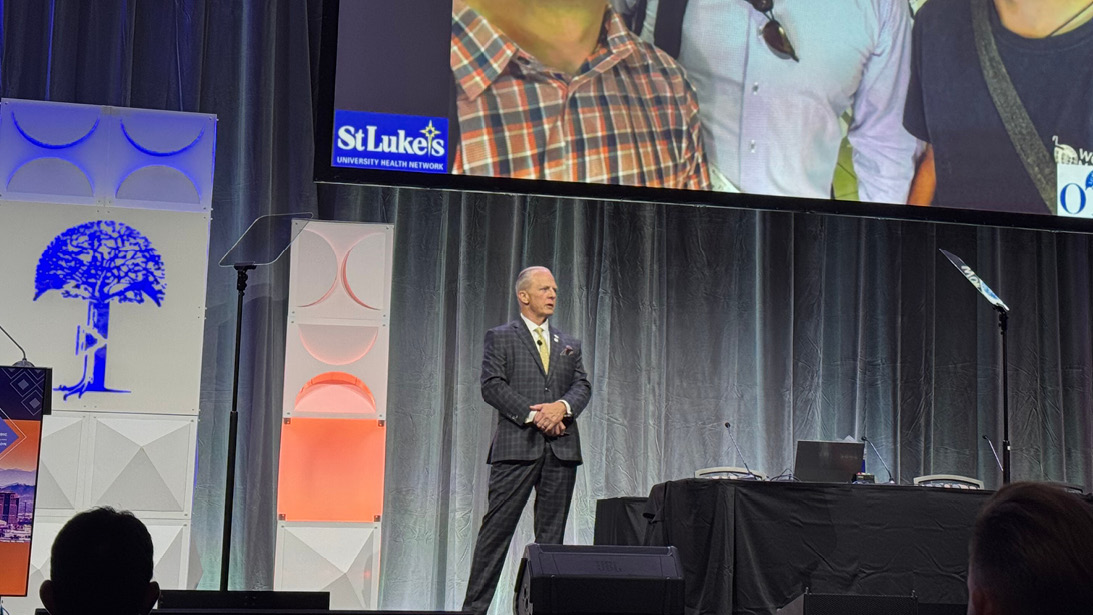
Douglas W. Lundy, MD, MBA, FACS, FAAOS, delivers his outgoing presidential address at the 2025 Orthopaedic Trauma Association Annual Meeting in November 2025.
Published 7/28/2026
|
Douglas W. Lundy, MD, MBA, FACS, FAAOS
At a Glance
- Orthopaedic surgeons should embrace grit while resisting the self-doubt and burnout that can accompany practice.
- Education, research, leadership, and charitable service offer meaningful pathways for professional fulfillment.
- Deliberate career planning can help surgeons avoid regret and maximize their impact on patients, colleagues, and communities.
Estimated read time: 5 minutes
Editor’s note: The following article is an abbreviated version of the speech Douglas W. Lundy, MD, MBA, FACS, FAAOS, outgoing president of the Orthopaedic Trauma Association (OTA), presented at the OTA Annual Meeting, Oct. 15-17, 2025, in Phoenix.
I titled my address as outgoing OTA president: “Basic Instructions Before Leaving Earth.” Twenty-eight years ago, this was the title of a popular hip-hop song, and I have always found that label to be quite profound. As we know too well, all of us will eventually depart from this Earth, and we will be remembered according to how much we invested in the lives of others.
All of us in orthopaedic surgery have an incredible station, entrusted by society, to provide empathic care to those most in need. In no specialty is this precept more authentic than in trauma surgery. We have been given a sacred gift that enables us to touch anguished patients and their families and provide them with a vision of hope and relief from suffering. Even after 26 years of practicing this craft, I never tire of the incredible privilege of being part of the team that provides bona fide comfort to an injured person. Do not let your weariness prevent you from cherishing that incredible human bond.
In her book “Grit: The Power of Passion and Perseverance,” Angela Duckworth explores how people with grit can maintain their determination and motivation over long periods despite experiences with failure and adversity.
Like many of you, I have had colleagues suddenly find the need to transfer patients with relatively simple fractures on a Friday afternoon, all because “they weren’t comfortable” with the injury. This idea of comfort flies in the face of grit.
We gave up the right to be comfortable when we started our surgical residency. We do hard things because we are often the best and sometimes the only hope that suffering people desperately need. And if that means we are temporarily uncomfortable so others may attain relief from pain and anguish, then so be it. So, join me in the crusade to do the right thing regardless of comfort — even if we are inconvenienced.
Now, the same unrelenting grit and drive that make us good trauma surgeons can also become our greatest weakness. Many of you are pursued by a spirit, a demon that whispers a repetitive narrative in your ear that you and your efforts are not good enough. Suboptimal outcomes and unhappy patients are all your fault. No matter how much you work, no matter how much you accomplish, that ever-present internal voice whispers self-doubt and condemnation. It drives you to fatigue and burnout, and it steals our profession of its most valuable resource, which is you at your best.
That demon haunted me for decades, but I did not face it until I was convalescing after cancer surgery six years ago. During that introspective time, my wife, Peggy, and I spent hours with each other while my body recovered from surgery, and I finally recognized the issue for what it was. Many of us are craving external validation, often from someone who has passed away and can never say the words we long to hear. So, on behalf of our profession, learn to quiet this voice and grant yourself grace.
I believe that when we first start, we have a vision of who we will become when we finally “make it.” The frantic business of surgical practice soon overwhelms us, and the urgent frequently supplants the important. Years tick by, and before long, opportunities are gone forever. We retire, unfulfilled, with a stack of money that can’t fill the void of missed opportunity.
It’s much too hard to get to where we are for this to be just a job. Society has invested tremendous trust in our profession, and to merely monetize that opportunity is a terrible waste of potential.
So, I have cadenced rounds with every one of the 98 physician partners in my practice where I implore them to seek out that vision, to develop a plan, and to work toward becoming the person they want to be when they finally step back from their career.
Are you called to these domains?
I believe there are four domains — education, research, leadership, and charity — that every professional should meditate upon and consider whether they have a calling to excel in that space. Excelling in each can bring some accolade to the individual, but if done correctly, the vast amount of energy from these activities is altruistic and outward facing.
The first is education. We have been given a gift that few possess, and it is our obligation to pass on what we have learned to subsequent generations. Whether that’s through teaching attending surgeons, residents, students, or allied health personnel, many of us have a passion and a gift for teaching. If you have that calling, start working on a plan to realize that vision now.
The second is research. While some are highly allergic to research, we are so glad that others among us thrive on it! Paraphrasing Marc Swiontkowski, MD, FAOA, these stars have “the disease” that makes them labor to produce high-quality research, understanding that personal gain is often far less than the investment they made in it. Regardless, if research is your thing, get on it immediately. Don’t wait for a better time in life.
Third is leadership. Many of us are called to lead — whether in our profession or in one of the other arenas of our lives. The OTA offers opportunities for you to lead at many levels. Whatever it is, get involved now!
Lastly, let me end on charity. Of all of us in the audience today, no one is in a better position to retire without regret than my friend Dan Galat, MD, FAAOS, a surgeon who has devoted more than a decade of his life to living among and caring for the poor in rural Kenya, East Africa.
Dan and his wife, Heather, raised their children and toiled day after day under the hardships of living in the developing world because they were called to minister to the less fortunate. I have had the tremendous blessing of supporting and working alongside him and other surgeons to relieve suffering among the underprivileged across the world. If this is your calling, please do it now! The “perfect” time will never arrive, and you are cheating yourself and others of the opportunity to serve in this capacity.
Consider what the image of your future self looks like. Solidify a plan and execute it. Whatever you do, finish well, and don’t have regrets. Live your whole life such that you may be able to say “I fought the good fight. I finished my work. Orthopaedic surgery has gained new luster by my life.”
Douglas W. Lundy, MD, MBA, FACS, FAAOS, is the outgoing president for the OTA and senior vice president of medical services and chair of orthopaedic surgery at St. Luke’s University Health Network in Bethlehem, Pennsylvania. He is also the deputy editor of AAOS Now and a member of the AAOS Now Editorial Board.