

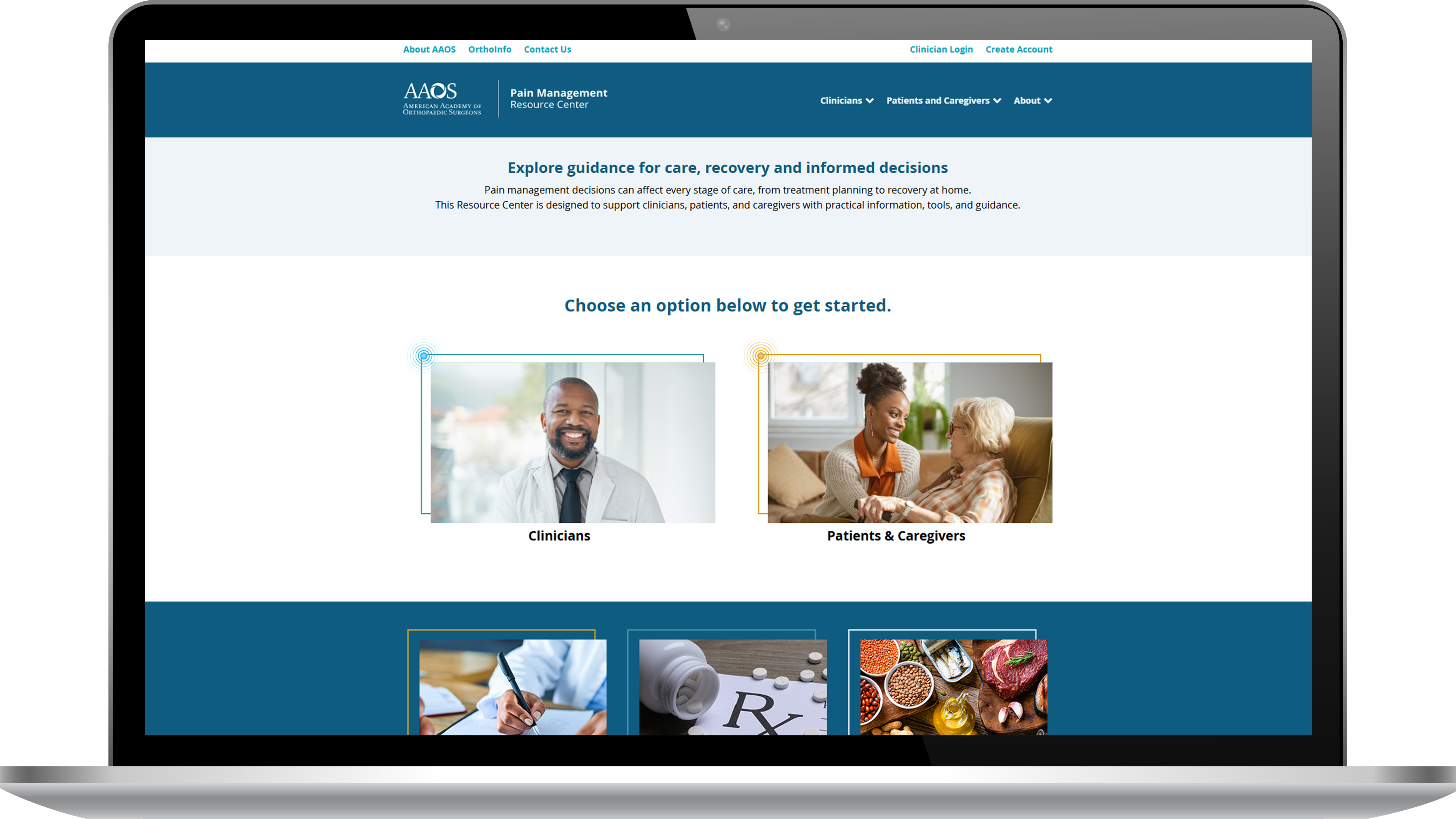
AAOS created the Pain Management Resource Center to provide surgeons with education, clinical guidance, and practical tools to support pain management and reduce opioid-related risks
Published 11/19/2026
|
Robert M. Orfaly, MD, MBA, FAAOS
At a glance
- The PMRC centralizes evidence-based pain-management guidance.
- Resources support multimodal care and opioid stewardship.
- Clinicians can share recovery and medication-safety materials with patients.
Estimated reading time: 5 minutes
AAOS is helping the musculoskeletal community to advance knowledge and improve pain management with the launch of the AAOS Pain Management Resource Center (PMRC), an online hub that brings together evidence-based research, clinical guidance, and practical tools for orthopaedic surgeons and patients.
Designed to guide pain management strategies before, during, and after treatment, the resource center aims to improve pain management while reducing opioid use.
“Orthopaedic surgeons must navigate evolving pain management strategies, patient expectations, and opioid-related risks to ensure patients receive appropriate pain relief while also considering a full range of treatment options,” said Adam Bruggeman, MD, FAAOS, FAOA, FAOrthA, co-editor of the PMRC and past chair of the AAOS Advocacy Council.
“With the PMRC, we have an opportunity to help the entire musculoskeletal care team and patients make more informed decisions that support recovery while incorporating multimodal approaches to reduce or eliminate postoperative opioid use when appropriate,” Dr. Bruggeman added.
The PMRC was developed with support from founding partners Brixton Biosciences, Curonix LLC, Pacira BioSciences, Inc., Vertex Pharmaceuticals, and Viatris. This builds on AAOS' work in pain management, including evidence-based guidance on pharmacologic, physical, therapeutic, and cognitive approaches to pain relief after musculoskeletal injury and orthopaedic surgery. The PMRC seeks to:
- help users find relevant information without having to search across multiple platforms;
- identify consensus questions and gaps in research where guidance has not kept pace with practice;
- help clinicians stay current with emerging evidence and newer approaches to pain management; and
- keep pace with policy changes that affect pain care and understand where education and advocacy intersect.
Vinod Dasa, MD, FAAOS, co-editor of the PMRC, believes the new center will help orthopaedic surgeons take an active role in shaping the future of pain management. (Dr. Dasa has disclosed consulting relationships with founding partners Curonix, Pacira, and Vertex Pharmaceuticals.)
“We need to demonstrate leadership in this space,” he said, noting that opioid prescriptions have increasingly become the focus of state and federal policy. He noted that orthopaedic leadership could affect how the Centers for Medicare & Medicaid Services (CMS) and other regulators approach pain-management policy. “If we want CMS and government regulators to view orthopaedic surgeons and physicians as true partners, then we’ve got to do the hard work and solve the problems.”
---
Related content
- Approach to Pain Management in Chronic Opioid Users Undergoing Orthopaedic Surgery (JAAOS®)
- Safe and Effective Alleviation of Pain and Optimal Opioid Stewardship (AAOS)
- Pain relief after trapeziectomy: What a double-blind study reveals about opioid vs. nonopioid care (AAOS Now)
---
Dr. Bruggeman, who is also board-certified in addiction medicine, added, “The federal government has shown an increasing awareness of pain management but also nonoperative and preventative treatments. Any shift to value-based care will require surgeons to manage the entire episode of care, incorporating concepts that extend well beyond surgery.”
Rethink opioid use after orthopaedic surgery
Although postoperative use of opioids has dropped as awareness of their dangers has grown, concerns about these drugs remain high. A 2026 study published in The Journal of Arthroplasty found that 9% of patients who were opioid-naive before total knee arthroplasty (TKA) continued taking opioids one year after surgery.
This research challenges assumptions about the routine use of opioids following total joint replacements, particularly as more procedures shift to outpatient facilities.
“There’s a perception that opioids are needed to get patients out the door the same day, but is this really necessary?” Dr. Dasa questioned.
In a 2022 study, Dr. Dasa and his research team discovered that 70% of opioid-naive patients undergoing TKA did not require opioids in the three months following surgery. Patients experienced no compromise in their pain and function compared to the groups that automatically received opioids.
These findings illustrate the type of evidence the PMRC offers for orthopaedic surgeons seeking to create individualized pain management strategies.
Resources offer practical guidance for clinicians
The PMRC provides orthopaedic surgeons and their care teams with practical information for treatment planning, patient conversations, and postoperative care.
Resources include perioperative pain management strategies, topic-based pathways, clinical education, and free continuing medical education courses. Clinicians can explore topics such as acute pain management, opioid stewardship, patient communication, recovery planning, stigma reduction, and trauma-informed care.
The PMRC will continue to evolve as new evidence and resources become available. Future content will include recommendations tailored to specific patient situations, such as managing pain in patients with chronic opioid use, as well as additional guidance to address emerging needs in orthopaedic pain management.
The center also offers tools and downloadable resources, including the AAOS Pain Alleviation Toolkit and postoperative pain protocols that can help translate evidence into clinical practice. Also included is a postoperative pain medication escalation protocol developed by Dr. Dasa. This protocol provides a step-by-step framework for managing pain based on anticipated severity, offering clinicians an effective alternative to postoperative opioids.
PMRC resources are organized around the clinical workflow, making it easier for surgeons and care teams to find information on preoperative care, preparation, perioperative care, and postoperative recovery. Many of these resources can be printed and shared with patients so they know what to expect.
Patient resources support recovery at home
Effective pain management extends beyond the clinical encounter. The PMRC wants to help patients better understand what may happen during recovery and know when to contact their care team with questions or concerns.
Patients and caregivers can access information about pain following orthopaedic surgery, non-drug recovery strategies, nutrition, and opioid safety through the PMRC. Procedure-specific resources focus on recovery following shoulder, elbow, foot and ankle, hip, knee, and spine surgery. Visual guides present pain management and recovery information in an easy-to-understand format.
The Pain Management Resource Center is available at aaos.org/pain.
Sponsored resources are clearly identified on the site, and AAOS notes that inclusion of sponsored materials does not constitute endorsement of a product, service, or treatment approach.
Robert M. Orfaly, MD, MBA, FAAOS, is a professor in the Department of Orthopaedics and Rehabilitation at Oregon Health and Science University. He is chair of AAOS’ Education Council, a former editor-in-chief of AAOS Now, and a member of the AAOS Now Editorial Board.