
Novel Technique to Avoid Vascular Injury During THA with CT-based Navigation
Introduction: Total hip arthroplasty (THA) is an effective treatment for patients with hip joint disorders. However, one of the significant complications during THA is vascular injury. In particular, the use of the screw fixation of the cup, bone grafting, or support rings in cases with bone defects requires drilling into the pelvis. This procedure increases the risk of laceration of major blood vessels. Computed tomography (CT)-based navigation system is a tool that allows surgeons to verify accurate placement of prosthesis according to preoperative planning. However, normal use of CT-based navigation system does not allow surgeons to track drill or screw tip in real-time during THA. This study presents a novel technique using CT-based navigation system to avoid injury of major blood vessels during fixation of the screws into the pelvis in real-time during THA.
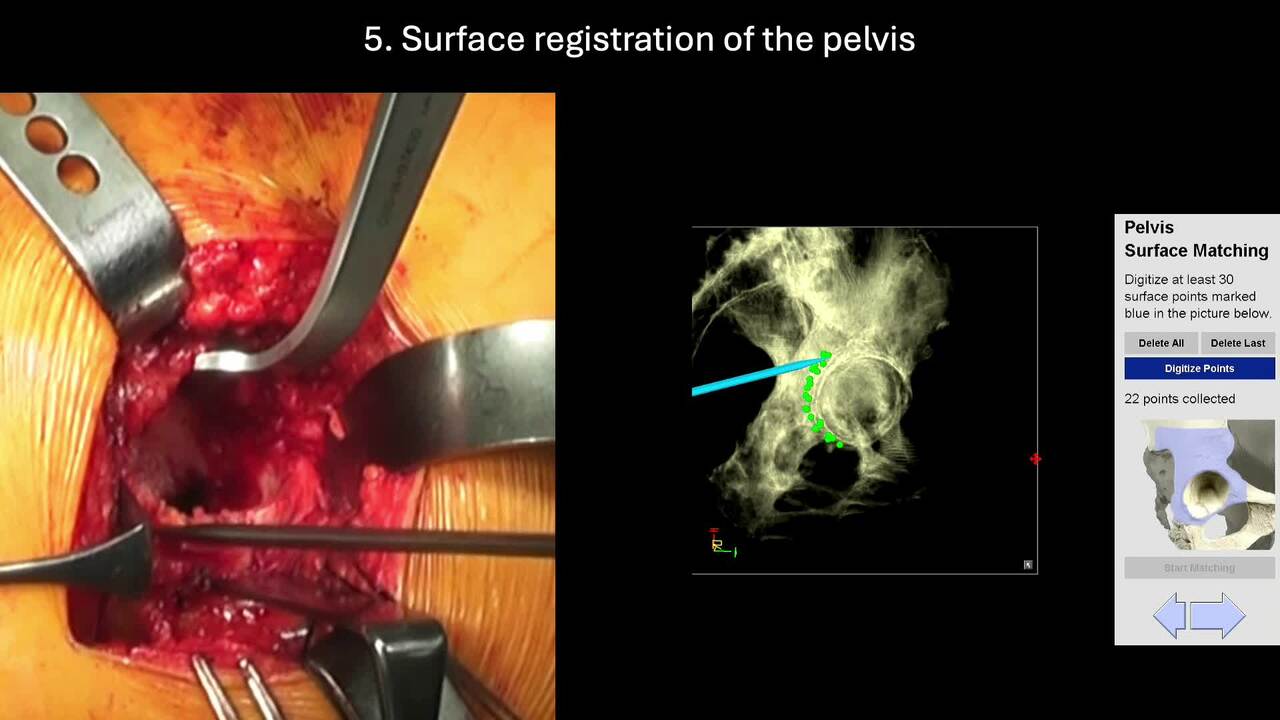
Methods of the novel technique: A CT-based navigation system developed for various orthopaedic procedures including osteotomy, oncology, hip arthroscopy, anterior cruciate ligament reconstruction, and trauma surgery is utilized for THA. First, a tracking device is attached to the base of the electric drill to identify the drill tip. Second, calibrating the drill tip and the tracking device connected to the drill allows for real-time tracking of the drill tip on axial, coronal, sagittal, and three-dimensional CT images displayed on the monitor. After completing these steps, surgeons can safely drill into the pelvis with real-time confirmation of the drill tip position and the location of the major blood vessels on the monitor.
Conclusion: This is the first study to show the novel technique to avoid injury to major blood vessels during fixation of the screws into the pelvis with acetabular reinforcement device using a CT-based navigation system. Our procedure revealed that this novel technique reduces the risk of vasucular injury in THA with screw fixiation. Therefore, our novel technique may be useful for surgeons to perform THA with screw fixation safely with CT-based navigation system. Further studies are needed to validate this technique in more clinical cases and to assess its effectiveness. Additionally, exploring the potential application of this technique in other surgical fields could offer further benefits.