
Four-Minute Rotator Cuff Repair: Tips to Performing an Arthroscopic Undersurface Rotator Cuff Repair
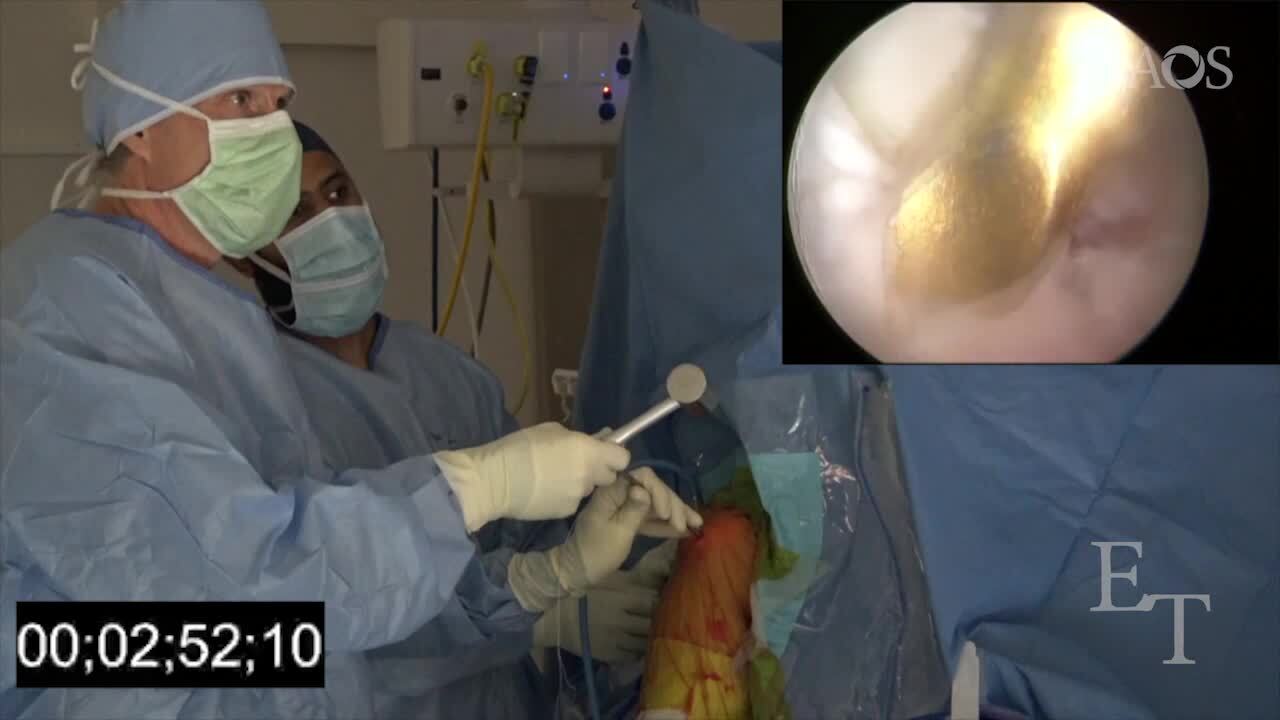
Background: Mean surgical times for arthroscopic rotator cuff repair range from 72 to 113 minutes. The senior author has achieved a mean surgical time of 16 minute and a surgical time as low as 4 minutes. This video shows uncut footage of arthroscopic repair that occurred in 4 minutes and discusses the equipment, setup, technique, rehabilitation, and outcomes associated with this type of repair. Objectives: This video demonstrates that rotator cuff repair can be performed in as little as 4 minutes. The equipment, setup, technique, rehabilitation, and outcomes associated with rotator cuff repair are discussed. Methods: A camcorder was used to capture images and video footage of undersurface rotator cuff repair, the equipment used, and rehabilitation exercises. Arthroscopic footage was captured using an arthroscope. These were edited. Results: Undersurface repair involves insertion of an arthroscope through a standard posterior portal and visualization of the rotator cuff from deep to superficial. Preparation of the landing site and repair of the tendon occurs via a single lateral portal without the need for the camera to enter the subacromial space. No cannulas are used. Bursectomy and acromioplasty are not necessary. Patients undergo a spinal block and sedation. The patient is prepared and draped in the beach-chair position. After the arthroscope is inserted in the posterior portal, a spinal needle is inserted to establish the location for the lateral portal (2 cm inferior and 1 to 2 cm posterior to the anterolateral border of the acromion), which helps visualize the trajectory of the instruments to the torn tendon edge. The skin incision is made with a No. 11 blade. An arthroscopic shaver (usually 4 mm) is used to prepare the landing site of the torn supraspinatus by removing any tendon fibers. The edges of the torn tendon are preserved as much as possible. An arthroscopic suture passer is used to pass a suture through the torn tendon edge in an inverted mattress suture configuration. More sutures are passed in the same fashion for larger tears. A T handle and a mallet are then used to create a landing site hole for each anchor. The suture is passed through a knotless anchor delivery system. The T handle is removed from the landing site, and the knotless anchor delivery system is then placed in the hole and deployed. The suture is then wound in and captured in the anchor by squeezing the trigger a second time, completing the repair. Rehabilitation occurs over 6 months and involves range of motion and isometric strength and resistance band exercises. The undersurface technique results in a low retear rate and similar functional outcomes compared with arthroscopic repair performed from the bursal side with the use of the same system.